RESUMÉ

Julio Eduardo de Jesús Ramos Talavera (Mexico City, 1971) is a writer, journalist, consultant, and researcher with academic training in Communication Sciences and Philosophy from the National Autonomous University of Mexico (UNAM), where he received the Alfonso Caso Medal for his doctoral research in 2018. He also holds diplomas in Political Foresight and Scenario Planning from the Ibero-American University (UIA), and in New Journalism from the Monterrey Institute of Technology and Higher Education (ITESM).
His areas of interest and specialization include ancient Greek religion and philosophy, the tragic tradition, and German thought—particularly the works of Friedrich Nietzsche and Martin Heidegger. The historical confrontation between these thinkers, combined with his early academic training in physics and mathematics, has led him to explore communication strategies for conflict resolution, as well as the philosophical implications of quantum theory, chaos theory, systems theory, and the broader evolution of scientific rationality in the West.
Julio Ramos Talavera currently works as a consultant, analyst, and researcher in political communication and strategic affairs for both public institutions and private entities in Mexico. He has also served as a professor at IMECICH, where he has taught seminars such as Ethics and Contemporary Thought and Social Welfare and Sustainable Solutions. In addition, he has been a part-time lecturer at Universidad del Valle de México (UVM), where he taught Research Methodology, Ontology, Applied Research in Education, New Trends in Education, and Political and Socioeconomic Issues in Mexico.
Latest Published Content
- Author: J.E.J. Ramos Talavera
- Title: Luz y Oscuridad en la Caverna. Reflexión en torno a la posibilidad de un nuevo comienzo (del pensar).
- Published in: Pensar Occidente: Ontologías del Siglo XX,Rebeca Maldonado Rodriguera (Coordinadora), México, FFyL-UNAM, 2018, ISBN 978-607-30-0654-5, págs. 393-404
- Language: Spanish
- Available: [Libros UNAM] Download: [Article]
____________________________________
- Author: J.E.J. Ramos Talavera
- Title: Eros y Eris. La Pérdida del Cosmos tras la Muerte de Dios.
- Published in: Hermenéuticas del Cuidado del Sí: Cuerpo Alma Mente Mundo / Teresa Oñate y Zubía (ed. lit.), Marco Antonio Hernández Nieto (ed. lit.), Paloma O. Zubía (ed. lit.), José Luis Díaz Arroyo (ed. lit.), León Ignacio Escutia (ed. lit.), Sebastián Lomelí (ed. lit.), Vol. 2, Madrid, Dikynson, 2017, ISBN 978-84-9148-482-0, págs. 649-662
- Language: Spanish
- Available: [UniRioja] [Torrosa] [Dijuris] [IpChile] Download Article:[Dikynson]
____________________________________
- Author: J.E.J. Ramos Talavera
- Title: Circularidad, Temporalidad e Historia. Una aproximación desde el pensamiento heideggeriano.
- Published in: Tránsito(s) y Resistencia(s). Ontologías de la Historia. Rebeca Maldonado Rodriguera (Coordinadora), México, FFyL-UNAM, 2017, ISBN 9786070295652, págs. 203-212
- Language: Spanish
- Available: [LibrosUNAM]
Artículos
Publicaciones, artículos, investigaciones y proyectos. El contenido aquí expuesto es original y sujeto a derechos de autor. Se prohíbe toda copia o reproducción parcial o total, sin el permiso expreso del autor.

La Presencia del Monismo en la Física Moderna
Entre la física y la filosofía, entre el deseo de determinación y la cercanía a lo indeterminado, se busca una conversación donde ambas se reconozcan atravesadas por lo que no dominan.

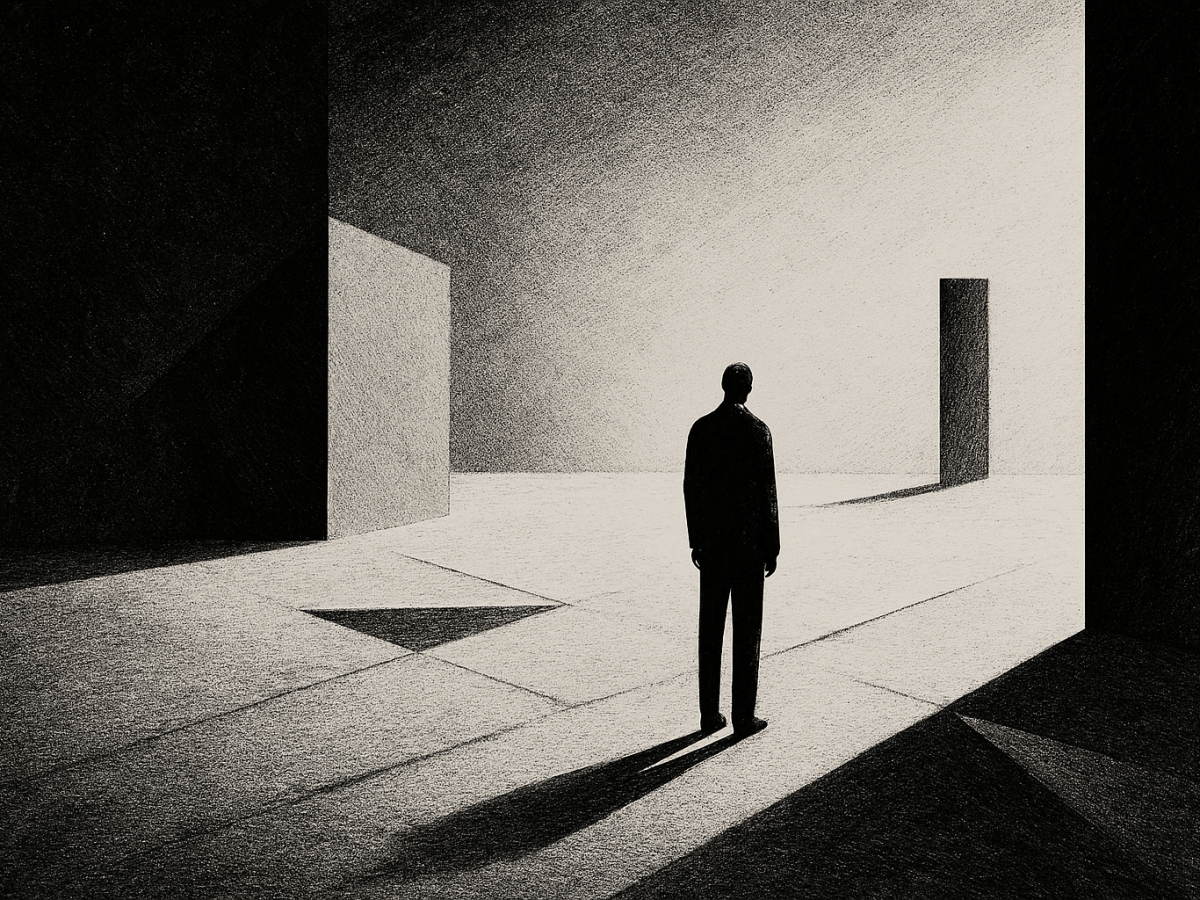
Sentido y Vacío: la extrañeza de lo cotidiano.
Ver una calle, un rostro, un libro sobre la mesa, no es simplemente registrar lo que hay, sino experimentar su presencia cargada de posibilidad sobre el fondo de nada.

Lo que aún no ha sido
Vivimos rodeados de certezas aparentes, de nombres que fijan lo que vemos, de historias que cierran posibilidades. Pero ¿y si lo «real» fuera apenas un instante entre infinitos mundos posibles?
Thresholds of Thought
Thresholds of Thought is a space for philosophical confrontation — not as academic exercise, but as lived urgency. Each episode crosses a threshold: between idea and experience, between the political and the personal, between silence and speech.
Here, the history of thought meets the convulsions of the present: war, loss, love, collapse, resistance. From Heraclitus to Heidegger, from the tragic to the systemic, from myth to chaos — philosophy is summoned to stand where the ground trembles.
This is not a place of answers. It is a place of rupture, of listening, of radical questioning.
Because thought, when true to its essence, does not explain — it exposes. It exposes us to the mystery, the danger, the unbearable brightness of being.
Welcome to the thresholds. Not everyone comes back.


